Gotta Garden
Showing posts with label Garden Bloggers Book Club. Show all posts

Friday, September 14, 2007

Garden Bloggers Book Club; Garden Reading

(Can you believe it?? It's not midnight at the end of the month...I'm early! Maybe I get a gold star...maybe?)

Carol of May Dreams Garden has suggested our book for this period and is the de facto president and hostess of our Garden Bloggers Book Club (Carol, I hope you don't mind the title! I mean it well.). Her choice is A Hoe Lot of Trouble by Heather Webber. Thanks, Carol, for a great suggestion! To my review...

What makes a garden novel enjoyable? First, it needs to be about a garden or gardener. Second, it should read quickly as it is not a reference book, per se; however, helpful information interspersed throughout is a plus. Third, the characters should be likeable enough that you would enjoy reading about them again.

A Hoe Lot of Trouble scores perfectly (for me) in all three categories listed above. Sometimes you just want to read for pleasure. I liked it well enough that I quickly read the second one in the series, Trouble in Spades, as well as the third one, Digging Up Trouble. There is a fourth one that I’ll probably be ordering very soon.

I do have a slight disagreement with something in the second book, but I’ll save that for the end. (Obviously, it wasn’t serious enough for me to stop reading the books!) On to the books…let me just say that if I am vague, it is intentional because I want you to read and enjoy these books…and not have the story spoiled.

Nina Quinn is the main character (hence, Nina Quinn Mysteries). The books revolve around her landscaping business Taken by Surprise and her interactions with family and friends. Because Nina’s life continues to evolve through the books, I’ll just say that it’s all very entertaining. The dialogue is witty and the books are fast paced. The books are murder mysteries, so in the fashion of Murder She Wrote (wherein one would probably not want to vacation in Cabot Cove due to the high murder rate), murders seem to occur regularly in the small Ohio town she resides in…and Nina is somehow right in the middle of them. Struggling in her personal life, successful in her business, she presents a character many of us could identify with. Her food choices are pretty amusing in their own right. She appears to fuel herself on cookie dough, candy bars and other foods stress eaters can identify with.

There are lots of things to admire about Nina. She’s loyal, caring, adventurous, hard working…and conflicted. Her family has an assortment of characters that become more familiar to you, the reader, with each book. I’m not sure I’m totally with the author in the direction she seems to be taking Nina’s life, but I’m leaving room to be convinced. The journey is pleasant enough and with my husband having Ohio roots, I also enjoy the references to places that are familiar.

So, if you are a murder mystery reader like me, then these are fun books. I think I read all three in less than a week. If you had the time, you could easily read one over a weekend (great to take on a trip!).

Now, I know you’re just waiting to hear what I didn’t like. In book two, Trouble in Spades, Nina mentions that “day lilies” are poisonous. The author takes that further in the section at the end purportedly written by Nina Quinn called Take Your Garden by Surprise. On page 380, under Know your plants, we are told:

"Certain bulbs are toxic too, like amaryllis, lily of the valley, tulips, daffodils, and day lilies."

Sigh. Giant sigh. Do you see it, faithful readers?? Let me back up a minute and bring you up to speed in that a dog in this book becomes ill after eating morning glories. The informative section at this end of this book (the first one dealt with poison ivy, the third with a hummingbird garden) deals with protecting your dog from harmful plants.

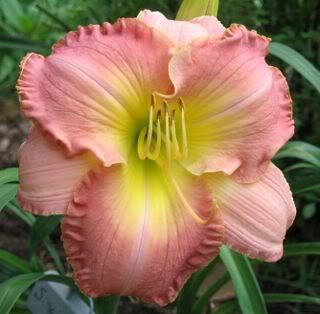
As someone who has hundreds of “day lilies” (you know, of course, that they are daylilies…one word), they are NOT toxic. I, myself have eaten daylily blooms. One of my cats regularly munches on daylily seedlings in the window during the winter. There are recipes for cooking with daylilies! The American Hemerocallis Society makes an effort to correct misleading information (or just plain confused) information and this looks like a case for them. I have seen discussions in the past on the email robin on this very topic.

The most obvious thing should have jumped out at you right away. Daylilies are NOT bulbs!!!! I suspect the author is referring to true lilies (lilium) which are bulbs. With a character who is supposed to be a credible landscaper, shouldn’t she know the difference??

Here’s a link that took me about two seconds to find. You’ll note the author of this page says that some of these cannot be verified. I would question a few, right away…tulips/crocus…how many squirrels have dug up and run off with these? And, we know deer love tulip flowers (which are contained in the bulbs)…Before my cats, the rabbits loved my saffron crocus. I guess orris root was forgotten as well (it is an iris). BUT, you’ll note what is not on there….that’s right, hemerocallis, i.e., daylilies. As you can see, it is easy to be confused about what is and isn't a problem.

I must say, for me, this a glaring error and cast doubt on the “garden creds” of the author and her character, Nina Quinn. At the end of the third book, I didn’t even read the information about hummingbird gardens and found that I skimmed her plant references in the book. (I’m harsh, I know).

Having said all of this, I still enjoyed the books. It would be nice to have the character be better informed, but I have also attended lectures from landscapers whose plant knowledge was more general than specific. It didn’t spoil the lecture. Thus, this doesn’t spoil the books for me. And, I hope not for you as well.

*****

American Hemerocallis Society


Thursday, May 31, 2007

GBBC: Passalong Plants

Passalong Plants by Steve Bender and Felder Rushing is a compendium of favorites by two well known garden writers. Both are beloved for their wit and humor and these are not lacking in the subjects covered here. It's hard to imagine that anyone who gardens will not find more than few plants they know and recognize.

I usually turn right to the index where I can find a plant by its common and/or botanical name. The plants here are ones that persevere in spite of us and reproduce with generosity, hence the ability to pass them along. I find it a fun exercise to see how many are in my garden. More than a few, I can tell you!

One of my favorite passages is on Crinums and entitled Crinums Never Die. Now, that's a plant to consider! Having seen them blooming north of me, I knew I wanted to try one for myself. That one turned into two. Here's a picture of the larger of mine (if you'll look carefully, you'll see some Hardy Begonias starting to come up in front of the Sweet Woodruff):


Here's the other with Balsam seedlings coming up around it. As Felder says, "If you fail with crinums, you may as well quit." With such encouragement, I'm proud to tell you that mine are alive. Maybe this year they'll actually bloom (finally)...one can always hope.


Actually, I think Mr. Felder might also say that about Tiger Lilies. Last year, I spent quite a bit of time digging mine out as they had gotten huge and seemed intent on taking far more real estate than I wanted them to have as well as their reputation for harboring a lily virus. Imagine my surprise upon seeing them back in "their" spot, looking as if I had dreamed all that effort last year.

Excusing the hose, here are a few other passalongs I enjoy. The Banana Shrub you've seen me post before, but you might not have realized there's a dwarf canna in front of it. To the right you see Butterfly Ginger with Tuberoses coming up in front. (Yes, those are weeds...we'll pretend they're not there.) All of these (knock on wood) have endured at least two winters here, so I consider this little patch my microclime area.


Many of the shrubs the authors write about are delightful and more than a few have a home here. I was surprised to not see Tea Olive listed as the fragrance is wonderful as well as Confederate Jasmine. Then, I realized that Gardenias were not included (What's a Southern garden without Gardenias, I ask?? Okay, a Southern garden in zone 8 and above, that is.). Maybe they don't "passalong" as well? Maybe they're more readily available? Who knows.

There are a few that one would hope would not be unknowingly passed along such as Artemesia, Empress Tree, Kudzu and Star of Bethlehem. To their credit, the authors mention their rapid spread, even in a funny way, such as with Star of Bethlehem Steve Bender, after advising of their rapid increase, says, "We really do need to keep passing them along, you see. Else, how will they make it to Hawaii or the Falkland Islands?" If you've ever tried to eradicate any of these, you know it is nearly impossible. There are a few others I would politely disagree with the authors on, but that is just a matter of personal preference, I suppose. Even in disagreement, I enjoy reading both of these writers' works.

For me, a favorite passalong came from my mother. She calls it a Blood Lily (Scadoxus). Last year, it finally bloomed for me and as of right now, it's just starting to appear. Inadvertently, another passalong rode in the pot. Balsam seedlings made a surprise appearance as my mother had grown them nearby. There are several passalongs in my garden from the Mary Washington House, among them Naked Ladies and Larkspur.


Now, I'm off to visit May Dreams Gardens to see what other garden bloggers are saying about Passalong Plants.

Wednesday, April 11, 2007

Garden Reading: Garden Bloggers Book Club March Selection

Our title for March was The Gardener's Year by Karel Capek. This book is part of a wonderful series of garden books edited by Michael Pollan (author of Second Nature, among others) called Modern Library Gardening. As Pollan says, these books are classics and not necessarily reference or how-to books but rather "how-to-think-about-it-than-how-to-do-it."

Diverse as we gardeners may be, there are also universal truths and experiences that bond us. The best of garden writers remind us, amuse us, and yes, at times, challenge us as we journey on our personal garden paths. Karel Capek's vocation was writing (at which he clearly excelled) but he, too, had that universal passion that gardeners recognize in one another. It's more than just a hobby as Mr. Capek's wit and humor remind us.

The format of the book is month by month, which happens to be my favorite. It also causes me to fight with myself as I have to make myself read past March while in March. I can convince myself to go a month or so ahead, but beyond that the messages in my brain compete with the text. "Why are you reading about July, for pity's sake, when it is March....March, you know" and other similar conversations distract me and convince me I won't remember what I've read. As you might guess, my nightstand has more than a few such books there that I like to read and re-read as the days go by. They never get old and I turn to them again and again. Certainly, A Gardener's Year has joined the pile.

Speaking of March, the chapter in Mr. Capek's book is entitled Buds and begins with the universal truth of gardeners waiting, waiting, waiting for the first bud. and for the "imperative 'Now!'" that happens when things burst forth all at once as if on cue. It was a personal Yes moment for me when he talked of (if he were a musician) composing a "march of buds" to describe the process. I, too (that universal thing), have thought that events in the garden remind of me a well orchestrated musical piece, although in my case, I had thought of a symphony rather than a march. He description hit such a chord with me that I marked the page to return to and savor.

Because I felt compelled to move on (although not wanting to), I did read on into April where I discovered another laugh out loud moment. The description of the gardener scurrying around the garden looking for a spare inch in which to plant something, finding it at last, only to discover later that he has indeed planted the new plant on top of something else. Who hasn't done that?! (Ahem, and who now has label mania??) And, speaking of labels, who could not be amused (and say, "true, so true") as we read of the gardener's obsession with labels and plants that lack thereof. The gentle pokes of fun at those of us consumed with our Latin names and our intolerance of those who don't know same. I love this particular passage:

"It is almost the same, but a name is a name; and we gardeners are particular about good names. For that reason we hate children and blackbirds, because they pull out and mix the labels, and it sometimes happens that we say with astonishment: "Look here, this broom flower is exactly like edelweiss--it is perhaps a local variety; and it certainly is a broom, because it has my label."

May was also a month of great amusement (as I would expect all are) with tales of the gardener obsessed with the rare and different only to discover the plant is most certainly not rare or different. There is the trouble with ordering plants. First, it is too early, then the supplier is too busy and finally, the supplier is sold out, but will send you something entirely different than what you want. Universal experiences and "the more things change, the more things stay the same" that we all relate to.

It is hard to imagine a garden library without this delightful little book. It will be with pleasure that I turn to it in the coming months to share experiences with Karel Capek. And, isn't that just the grandest thing? That time almost stands still among gardeners and we can have conversations with others before us and know exactly what they mean.

*******
My apologies for being late to this party. I'll try to do better from here forward. Although, I do note with the next book that it, too, is not one I'd sit down and read straight through. I like it and have owned it for some time, but find I turn to a particular plant at a particular time...more about that next time, though!

*******
Please see The Garden Bloggers Book Club.
Related Posts with Thumbnails